Swarm & Computational Intelligence
Laboratory


The Swarm and Computational Intelligence Laboratory (SwaCIL) was established in 2018 at the University of Manchester and moved to the Department of Computer Science at Durham University in 2022.
SwaCIL develops collective robotic systems that operate in real-world environments and interact with living systems. Our research spans swarm robotics, biohybrid robotics, environmental monitoring, micro-mechatronics, and the design of specialised robotic platforms. We combine decentralised control, sensing, hardware development, and long-term experimentation to study how robots can coordinate, adapt, and become functionally integrated with biological and environmental systems.
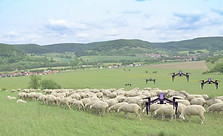
Our work is grounded in physical experimentation. We develop robotic systems for applications ranging from monitoring and interacting with animal societies to observing aquatic environments and testing collective behaviours at scale. Our broader goal is to translate principles from natural collective systems into reliable robotic technologies while developing new forms of cooperation between robots, organisms, and their environments.


Robotic Platforms - Equipment


Research Topics
-
Research Areas
SwaCIL investigates collective robotic systems that operate in real-world environments and interact with biological and ecological systems. Our research combines fundamental studies of collective behaviour with the development of specialised hardware, sensing technologies, and long-term experimental platforms.
-
Swarm Robotics and Collective Systems
We study how groups of relatively simple robots can coordinate through local sensing and decentralised interaction. Our research covers collective motion, aggregation, task allocation, and heterogeneous swarms, with a strong emphasis on physical experiments and scalable real-robot systems. We develop and use platforms including Colias and Mona, alongside newer bespoke systems, to test collective behaviours beyond simulation.
-
Biohybrid Robotics and Living Systems
We develop robotic technologies that can observe, interact with, and support living systems over extended periods. Our work includes robotic systems for honeybee colonies, animal-robot interaction, automated observation, and closed-loop intervention. A central goal is to understand how engineered devices can become functional components of biological collectives without replacing their natural organisation.
-
Environmental and Ecological Robotics
We design robotic systems for long-term monitoring in natural and managed environments. Our research includes aquatic biodiversity monitoring, environmental sensing, ecological observation, and operation under difficult field conditions. We focus on persistent autonomy, low-power operation, reliable data collection, and deployment outside controlled laboratory environments.
-
Decentralised Control and Collective Intelligence
We develop models and control methods for multi-agent and swarm systems operating without central coordination. Our research addresses formation control, containment, distributed decision-making, and robustness to uncertainty or individual failure. We connect theoretical analysis with physical experiments to understand how local interactions can produce reliable collective function.
-
Mechatronics and Robotic Platforms
We design and build specialised robotic platforms, miniature robots, embedded sensing devices, and experimental infrastructure. This includes biohybrid interfaces, field-deployable systems, and custom mechanisms for applications where commercial robotic platforms are unsuitable. Our work combines mechanical design, electronics, control, and full-system integration.